
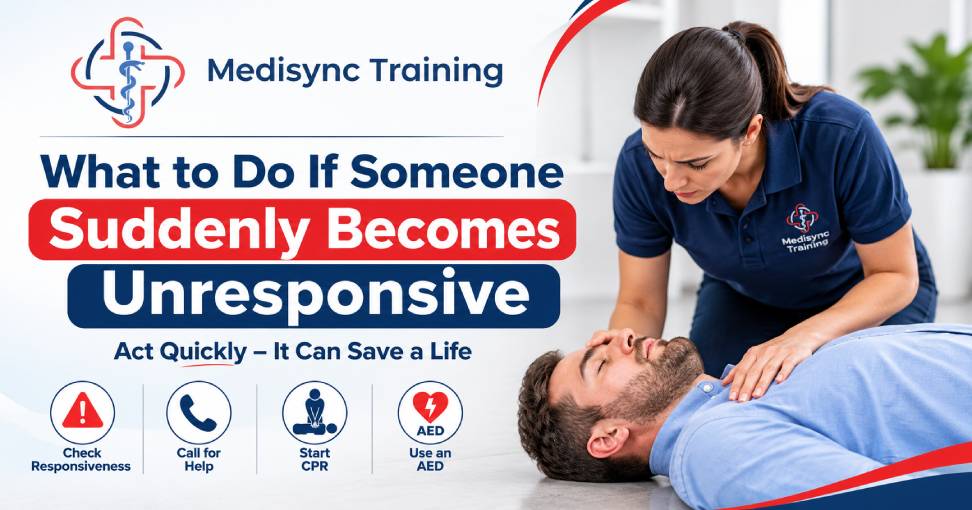
What to Do If Someone Suddenly Becomes Unresponsive: A Step-by-Step First Aid Guide
November 10, 2026
When someone suddenly becomes unresponsive, every second matters. Whether it happens at home, in the workplace, in a public place, or during physical activity, knowing how to respond can make a life-saving difference. An individual who suddenly loses consciousness may be experiencing a cardiac arrest, stroke, seizure, severe allergic reaction, low blood sugar, or another serious medical emergency.
In these situations, staying calm, recognising the warning signs, calling emergency services, and providing appropriate first aid are essential. You do not need to be a medical professional to help someone in an emergency. However, having the right first aid knowledge and knowing what actions to take can significantly improve the person’s chances of survival.
This guide explains what to do when someone suddenly becomes unresponsive, including how to assess their condition, when to perform CPR, and how to provide assistance until professional medical help arrives.
1. Recognise the Signs of Unresponsiveness
A person is considered unresponsive when they cannot be awakened or do not react appropriately to their surroundings.
Common signs include:
-
They do not respond when you call their name.
-
They do not react when you gently tap their shoulders.
-
They appear unconscious or have collapsed.
-
Their breathing is absent, abnormal, or limited to occasional gasps.
-
They do not follow simple instructions or respond to stimulation.
Unresponsiveness should always be treated as a medical emergency, particularly when the person is not breathing normally. Do not assume they are sleeping, intoxicated, or simply exhausted.
2. Check the Surroundings Before Approaching
Before helping an unconscious person, check whether the surrounding environment is safe. Rushing into a dangerous situation could put both you and the casualty at risk.
Look for potential hazards such as:
-
Moving vehicles or road traffic.
-
Exposed electrical wires.
-
Fire, smoke, or gas leaks.
-
Dangerous machinery.
-
Chemicals or hazardous substances.
-
Broken glass or unstable structures.
If the area is unsafe, avoid approaching until the danger has been controlled. Ask bystanders for assistance and contact emergency services.
Once it is safe, approach the person carefully and prepare to assess their condition.
3. Check Their Responsiveness
Try to determine whether the person is conscious and able to respond.
Follow these steps:
-
Speak loudly and clearly, asking, “Are you okay?”
-
Gently tap their shoulders if there is no suspected injury.
-
Look for any movement, verbal response, or other signs of awareness.
-
If there is no response, immediately ask someone nearby to call emergency services.
If you are alone, use your mobile phone on speaker mode so you can communicate with the emergency operator while assisting the person.
Avoid shaking the casualty forcefully, as this could worsen an existing neck or spinal injury.
4. Open the Airway and Check for Normal Breathing
If the person does not respond, check their airway and breathing immediately.
Follow these steps:
-
Carefully place the person on their back on a firm, flat surface if necessary.
-
Gently tilt their head backwards and lift their chin to open the airway.
-
Look for movement in their chest.
-
Listen for breathing sounds.
-
Check for normal breathing for no more than 10 seconds.
It is important to distinguish normal breathing from occasional gasps. Gasping, irregular breathing, or unusual noisy breaths may indicate cardiac arrest.
If the person is not breathing normally, do not waste time. Start CPR immediately.
5. Call Emergency Services Immediately
If someone is unresponsive, contact emergency medical services as soon as possible, even if they appear to be breathing normally.
In Australia, dial 000 (Triple Zero) and request an ambulance.
When speaking to the emergency operator, provide:
-
Your exact location.
-
What happened to the person.
-
Whether they are conscious or unconscious.
-
Whether they are breathing normally.
-
Any visible injuries or other concerning symptoms.
Follow the operator’s instructions carefully. If another person is present, ask them to make the emergency call while you continue providing first aid.
Early emergency assistance is essential because an unconscious person may deteriorate quickly.
6. Start CPR If the Person Is Not Breathing Normally
Cardiopulmonary resuscitation (CPR) is a life-saving procedure used when someone experiences cardiac arrest. It helps maintain blood circulation and delivers oxygen to vital organs until advanced medical assistance becomes available.
For an adult who is unresponsive and not breathing normally:
-
Place the person flat on their back on a firm surface.
-
Kneel beside their chest.
-
Position the heel of one hand in the centre of their chest, on the lower half of the breastbone.
-
Place your other hand on top and interlock your fingers.
-
Keep your arms straight and position your shoulders above your hands.
-
Push down approximately 5–6 cm.
-
Perform chest compressions at a rate of 100–120 compressions per minute.
-
Allow the chest to return to its normal position after each compression.
If trained and able, perform 30 chest compressions followed by two rescue breaths. Continue CPR until the person shows signs of life, emergency professionals take over, or you are physically unable to continue.
If you cannot provide rescue breaths, hands-only CPR is better than doing nothing. Follow the emergency operator’s instructions.
7. Use an Automated External Defibrillator (AED)
An Automated External Defibrillator (AED) is a portable medical device that can analyse the heart’s rhythm and deliver an electrical shock when required.
If an AED is available:
-
Ask someone to bring it immediately.
-
Switch on the device.
-
Follow its voice and visual instructions.
-
Attach the electrode pads to the person’s bare chest as illustrated.
-
Ensure nobody touches the person while the AED analyses their heart rhythm.
-
Deliver a shock if the device instructs you to do so.
-
Immediately resume CPR when directed.
An AED is designed to guide users through the process, so you do not need to be a medical professional to operate one. Do not delay CPR while waiting for an AED.
8. What If the Person Is Unresponsive but Breathing Normally?
Not every unconscious person requires CPR. If someone is unresponsive but breathing normally, the priority is to maintain an open airway and monitor their condition.
Follow these steps:
-
Carefully place the person in the recovery position on their side.
-
Tilt their head slightly backwards to keep the airway open.
-
Position their mouth so fluids can drain out.
-
Monitor their breathing continuously.
-
Keep them comfortable and protect them from becoming too cold.
-
Stay with them until emergency medical professionals arrive.
If you suspect a spinal injury, avoid unnecessary movement and follow the emergency operator’s instructions. However, maintaining an open airway and adequate breathing remains the priority.
If their breathing becomes abnormal or stops, turn them onto their back and begin CPR.
9. What Should You Avoid When Someone Becomes Unresponsive?
Incorrect first aid can sometimes make an emergency worse. Avoid these common mistakes:
-
Do not give food or water: An unconscious person may choke because they cannot swallow safely.
-
Do not slap or shake them aggressively: This may cause additional injuries.
-
Do not leave them alone: Their condition can change suddenly.
-
Do not place objects in their mouth: This can obstruct their airway or cause injury.
-
Do not assume gasping is normal breathing: Gasping can be a warning sign of cardiac arrest.
-
Do not delay emergency assistance: Call 000 as soon as possible.
-
Do not attempt CPR on someone who is breathing normally: Continue monitoring them and maintain an open airway instead.
Understanding these precautions can help bystanders avoid preventable mistakes during an emergency.
10. Why First Aid Training Is Important
Medical emergencies can happen anywhere, including homes, schools, offices, construction sites, and public spaces. Having trained individuals nearby can make a significant difference before an ambulance arrives.
First aid training teaches people how to recognise emergencies, assess casualties, perform CPR, use an AED, manage unconscious individuals, and respond confidently under pressure.
Practical training is particularly valuable because it allows participants to practise essential techniques rather than simply memorising instructions.
Organisations can also benefit from workplace first aid training by improving emergency preparedness and ensuring employees understand their responsibilities when an incident occurs.
Conclusion
Knowing what to do when someone suddenly becomes unresponsive can help save a life. The most important actions are to check for danger, assess responsiveness, call emergency services, check breathing and provide appropriate first aid.
If the person is breathing normally, maintain their airway and monitor their condition. If they are not breathing normally, start CPR, use an AED if available and follow emergency instructions.
However, emergency situations require more than theoretical knowledge. Learning practical first-aid techniques can help you respond with greater confidence when every second matters.
Build Your Emergency Response Skills with Medisync Training
Prepare yourself to handle unexpected emergencies with Medisync Training. Explore nationally recognised first-aid and CPR courses in Perth, featuring flexible online learning and practical training sessions.
Whether you are an individual, workplace employee or childcare professional, developing first-aid skills is an investment in everyone’s safety.
Popular Posts
-
Diabetic Emergency First Aid: Symptoms, Immediate Response and Essential Life-Saving Skills
November 20, 2026A diabetic emergency can happen suddenly and may become life-threatening if the right first aid...
-
Diabetic Emergency First Aid: What You Need to Know
November 18, 2026Diabetes is a common health condition that affects how the body regulates blood glucose (blood...
-
First Aid for Low Blood Sugar and Hypoglycaemia: Symptoms, Causes and Emergency Treatment
November 16, 2026Low blood sugar, medically known as hypoglycaemia, is a condition that occurs when the glucose...
-
Fainting vs Seizure: How to Tell the Difference
November 13, 2026Understanding the difference between fainting and a seizure is important because both conditions can cause...
-
First Aid for Fainting: What Should You Do?
November 11, 2026Fainting can happen suddenly and without much warning. A person may feel dizzy, weak, sweaty,...