
Choking First Aid Steps for Adults: A Complete Guide to Responding Quickly
August 24, 2026
Choking can happen suddenly while eating, drinking, or even when a small object enters the airway. Because a blocked airway can prevent oxygen from reaching the lungs, knowing the correct choking first aid steps for adults can make a critical difference while waiting for emergency medical assistance.
Recognising the signs of choking and responding quickly can help prevent the situation from becoming life-threatening. This guide explains how to identify choking, what to do when an adult is choking, and when CPR may be required.
Important: This article is for general educational purposes and does not replace professional first aid training. In Australia, call Triple Zero (000) for emergency medical assistance when required. St John Ambulance Australia recommends following the DRSABCD action plan during serious emergencies.
What Is Choking?
Choking occurs when a foreign object partially or completely blocks a person’s airway. Food is a common cause, but choking can also happen because of other objects or fluids.
A person with a partially blocked airway may still be able to cough, speak or breathe. A completely blocked airway is much more serious because the person may be unable to breathe, speak or cough effectively.
Without prompt assistance, severe choking can result in unconsciousness and cardiac arrest.
How to Recognise When an Adult Is Choking
Knowing the signs is the first part of providing effective first aid. An adult who is choking may:
- Clutch their throat
- Have difficulty breathing
- Be unable to speak normally
- Have a weak or ineffective cough
- Make unusual wheezing or high-pitched sounds
- Show signs of panic or distress
- Develop pale or bluish skin, particularly around the lips
- Become unconscious if the airway remains blocked
If the person can cough forcefully, encourage them to continue coughing. A strong cough may remove the obstruction without additional intervention.
Choking First Aid Steps for Adults
If an adult cannot breathe, speak or cough effectively, immediate action is required.
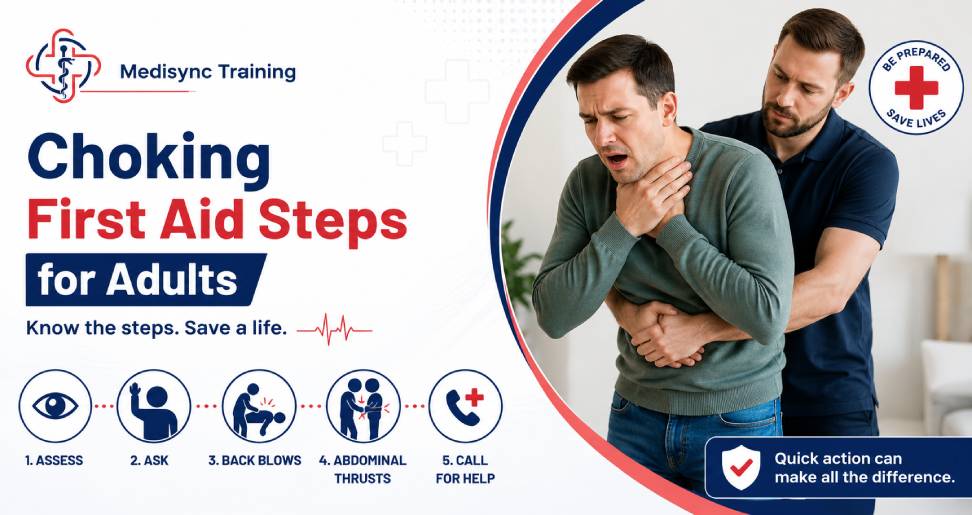
1. Stay Calm and Assess the Situation
First, make sure the environment is safe for you and the choking person. Ask the person if they are choking.
If they can cough effectively, encourage them to keep coughing and monitor their condition.
If they cannot breathe, speak or cough effectively, prepare to provide choking first aid and get emergency help.
2. Give Up to Five Back Blows
If coughing does not clear the obstruction, help the person lean forward while supporting their upper body.
Using the heel of your hand, deliver up to five firm blows between the person’s shoulder blades. Check after each blow to see whether the obstruction has been cleared.
Avoid giving unnecessary blows if the object has already been expelled.
3. Give Up to Five Abdominal Thrusts When Appropriate
If the back blows do not clear the blockage, abdominal thrusts may be used for a conscious adult in situations where they are appropriate.
Stand behind the person, place your fist above the navel and below the breastbone, hold your fist with the other hand, and deliver firm inward and upward thrusts.
Give up to five thrusts, checking after each one.
4. Continue Alternating Techniques
If the obstruction remains, continue alternating sets of up to five back blows and up to five abdominal thrusts while arranging emergency assistance.
Different circumstances may require modified techniques. For example, the American Red Cross recommends chest thrusts instead of abdominal thrusts for someone who is obviously pregnant or when abdominal thrusts cannot be performed effectively.
For Australian first aid guidance, St John Ambulance Australia recommends alternating up to five back blows with up to five chest thrusts for an adult or child over one year.
Because first aid protocols can vary by training system and situation, completing an accredited course is the best way to learn the correct technique for your location.
What If the Choking Person Becomes Unconscious?
If the person becomes unresponsive, place them on a firm surface and immediately seek emergency medical assistance.
Check their breathing. If they are not breathing normally, begin CPR according to your level of training and follow instructions from the emergency services operator.
St John Ambulance Australia’s CPR guidance recommends 30 chest compressions followed by two breaths, while compression-only CPR is better than doing nothing if a person is unwilling or unable to provide breaths.
If you are trained to do so, check the person’s mouth for a visible obstruction when appropriate. Never perform a blind finger sweep, as this can push an object further into the airway.
What Should You Avoid During a Choking Emergency?
Knowing what not to do is just as important as knowing what to do.
Avoid:
- Giving food or water to a person who is choking
- Asking them to swallow the obstruction
- Performing a blind finger sweep inside their mouth
- Leaving a severely choking person alone
- Delaying emergency assistance when the obstruction cannot be cleared
- Continuing forceful techniques after the obstruction has been removed
The priority is to maintain the person’s airway, provide appropriate first aid and obtain professional medical assistance when necessary.
Why First Aid Training Matters
Reading about choking first aid is useful, but emergencies can be stressful. Practical training helps people understand how to position a casualty, perform back blows and thrusts correctly, recognise deterioration and transition to CPR when necessary.
This is where professional First Aid Training can provide valuable hands-on experience.
Medisync Training offers nationally recognised training designed to develop practical emergency response skills. Its First Aid Certificate course, HLTAID011 Provide First Aid, includes CPR and covers emergency situations such as choking, bleeding, shock, fractures, asthma and anaphylaxis.
For people who specifically want to strengthen their resuscitation skills, CPR Training through the HLTAID009 Provide Cardiopulmonary Resuscitation course provides practical training in CPR for adults, children and infants.
Medisync Training also provides Childcare First Aid Courses, which can be particularly useful for educators and childcare professionals who need to respond to emergencies involving children and infants.
For organisations, Workplace First Aid Training and group training can help employees develop the confidence to respond to emergencies at work. Medisync Training provides onsite group sessions and flexible scheduling for workplaces, schools, childcare facilities, aged care organisations and healthcare environments.
How Medisync Training Can Help
Understanding emergency procedures from an article is a useful starting point, but practical instruction can help turn knowledge into confident action.
Medisync Training offers training delivered by experienced health professionals, including paramedics, nurses and emergency medical technicians. Its courses combine online learning with practical sessions, allowing participants to practise essential skills in realistic scenarios.
For workplaces that need training for multiple employees, Medisync Training also offers Group First Aid Training, with flexible scheduling and onsite delivery options.
Final Thoughts
Choking is a medical emergency that can develop from a seemingly ordinary situation within seconds. Recognising the warning signs, encouraging an effective cough, knowing when to provide back blows and appropriate thrusts, and understanding when CPR is required can help you respond more effectively.
However, written instructions cannot replace hands-on practice. Completing professional First Aid Training and CPR Training can give you the practical skills and confidence needed to respond when an emergency occurs.
For individuals, families, educators and workplaces in Perth, Medisync Training provides nationally recognised first aid and CPR courses designed to build practical emergency response skills.
Popular Posts
-
Choking First Aid Steps for Adults: A Complete Guide to Responding Quickly
August 24, 2026Choking can happen suddenly while eating, drinking, or even when a small object enters the...
-
Workplace First Aid Training Group Bookings Perth: A Practical Guide for Businesses
August 20, 2026Workplace emergencies can happen without warning. From cuts and burns to falls, allergic reactions, heat-related...
-
Anaphylaxis Action Plan Australia Template: A Practical Guide for Individuals, Schools and Workplaces
August 17, 2026Anaphylaxis is a severe and potentially life-threatening allergic reaction that requires immediate action. In Australia,...
-
How to Manage a Seizure at Work: A Complete First Aid Guide
August 14, 2026A seizure can happen unexpectedly in any workplace, whether in an office, warehouse, school, construction...
-
Burns First Aid Treatment Steps Australia: What to Do When a Burn Happens
August 12, 2026Burn injuries can happen unexpectedly at home, at work, in childcare settings, or while cooking....