
Common CPR Mistakes That Reduce Survival Rates
July 3, 2026
When someone suffers a sudden cardiac arrest, every second counts. Immediate, high-quality CPR can significantly improve the person’s chance of survival until emergency medical services arrive. Unfortunately, many people either hesitate to act or make common CPR mistakes that reduce the effectiveness of their efforts.
In Australia, thousands of people experience out-of-hospital cardiac arrests each year, yet survival rates remain relatively low. Research consistently shows that early CPR and prompt use of an Automated External Defibrillator (AED) can dramatically improve outcomes.
Whether you’re a workplace first aider, healthcare professional, parent, teacher, or everyday Australian, understanding these common CPR mistakes can help you respond with confidence when it matters most.
1. Delaying CPR Because You’re Unsure
One of the biggest mistakes people make is waiting too long before starting CPR. Many bystanders worry about doing something incorrectly or harming the casualty.
The reality is simple: doing something is almost always better than doing nothing. If a person is unresponsive and not breathing normally, CPR should begin immediately while someone calls Triple Zero (000). Every minute without CPR and defibrillation significantly reduces survival chances.
Professional CPR training helps remove uncertainty by giving participants practical experience in responding under pressure.
2. Chest Compressions That Are Too Shallow
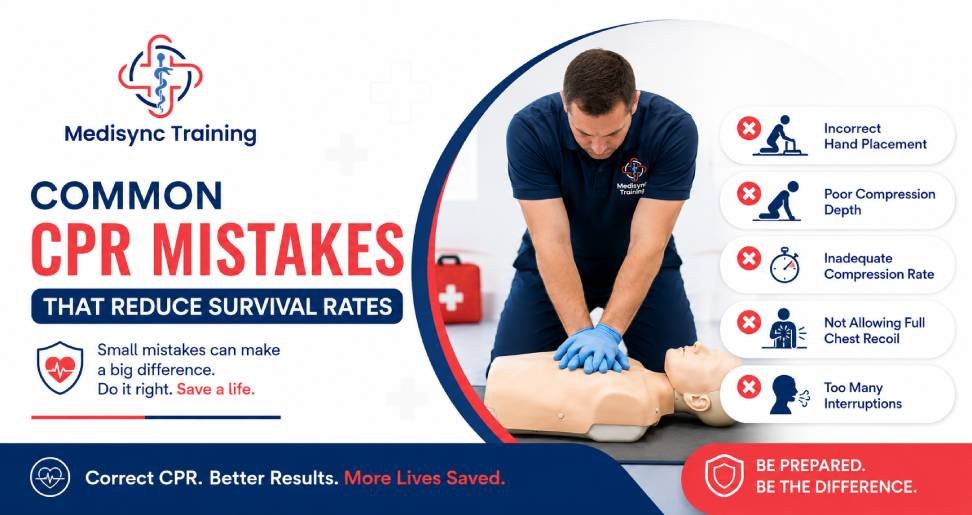
Effective chest compressions are the foundation of successful CPR. A common mistake is pressing too gently because rescuers are afraid of causing injury.
However, shallow compressions fail to circulate enough oxygen-rich blood to the brain and vital organs.
Australian CPR guidelines recommend:
- Compress the chest at approximately 100–120 compressions per minute.
- Push hard enough to achieve the recommended compression depth.
- Allow full chest recoil between compressions.
- Minimise interruptions whenever possible.
Proper hands-on training ensures these techniques become second nature.
3. Incorrect Hand Placement
Placing your hands incorrectly can reduce the effectiveness of chest compressions.
Your hands should be positioned in the centre of the chest on the lower half of the breastbone (sternum). Lock your elbows, position your shoulders directly above your hands, and use your upper body weight instead of only your arms.
Incorrect positioning wastes valuable energy while delivering less effective compressions.
4. Stopping CPR Too Often
Every interruption in CPR reduces blood flow to the brain.
Many people pause frequently to check for signs of life or become distracted during the emergency.
Instead, continue CPR with minimal interruptions until:
- Emergency services take over.
- An AED instructs you to stop.
- The casualty begins breathing normally.
- You are physically unable to continue.
Continuous compressions help maintain circulation and improve survival outcomes.
5. Forgetting to Call for Help Immediately
CPR alone is not enough.
Emergency medical services must be contacted as quickly as possible.
If other people are nearby:
- Ask one specific person to call Triple Zero (000).
- Ask another person to locate the nearest AED.
- Continue CPR without delay.
Giving clear instructions prevents confusion and saves precious time.
6. Not Using an AED
Many Australians are hesitant to use an AED because they believe it requires medical training.
In reality, modern AEDs provide clear voice prompts that guide rescuers through every step. The device analyses the heart rhythm and only delivers a shock if one is required.
Early defibrillation, combined with quality CPR, offers the best chance of survival following sudden cardiac arrest.
If you’d like to understand exactly how these life-saving devices work, read our guide on How to Use an AED in an Emergency.
7. Poor Airway Management
If you’re trained to provide rescue breaths, failing to properly open the airway is another common mistake.
Without a correct head tilt and chin lift, air may not reach the lungs effectively.
For trained rescuers, maintaining the recommended 30 compressions followed by 2 rescue breaths remains the standard approach under Australian guidelines. If you are untrained or unwilling to provide breaths, compression-only CPR is still strongly encouraged rather than doing nothing.
8. Letting Fatigue Affect Compression Quality
Performing CPR is physically demanding.
After just a few minutes, rescuers naturally become tired, causing compressions to become slower and shallower.
If another trained person is available, switch every two minutes while keeping interruptions as short as possible.
This simple strategy helps maintain high-quality CPR throughout the emergency.
Why Regular CPR Training Matters
Even people who have completed CPR training in the past often forget essential techniques over time.
Guidelines evolve, equipment changes, and confidence fades without practice.
Regular refresher training helps Australians:
- Build muscle memory
- Improve confidence
- Learn updated Australian CPR guidelines
- Practise realistic emergency scenarios
- Become familiar with AED operation
This practical experience can make all the difference during a real-life emergency.
If you’re interested in modern training methods, explore our article on How Blended Learning Is Changing CPR Training in Perth, which explains how flexible learning options are making CPR education more accessible than ever.
Learn with Medisync Training
If you’re looking for professional CPR and first aid education in Australia, Medisync Training provides practical, nationally recognised training designed for workplaces, healthcare professionals, educators, parents, and community members.
Their experienced trainers focus on realistic, hands-on learning so participants develop the confidence to respond quickly during cardiac emergencies. From CPR certification to comprehensive first aid programs, Medisync Training equips Australians with the practical skills needed to help save lives.
By choosing quality CPR training, you’re investing not only in your own knowledge but also in the safety of your family, colleagues, and community.
Final Thoughts
Cardiac arrest can happen anywhere—at home, at work, on the sports field, or in public places. Knowing how to perform CPR correctly can be the difference between life and death.
Avoiding common mistakes such as shallow compressions, unnecessary interruptions, delayed emergency calls, and failing to use an AED can dramatically improve survival outcomes.
The best way to prepare is through regular, practical CPR training. With trusted providers like Medisync Training, Australians can gain the confidence and skills needed to act decisively when every second counts.
Remember, the best CPR isn’t perfect CPR—it’s CPR that starts immediately and follows the correct techniques until professional help arrives.
Popular Posts
-
Warning Signs of Heart Attack: An Essential Action Plan
September 7, 2026A heart attack can happen suddenly, and recognising the warning signs early can make a...
-
How Proper Medication Training Reduces Risks for Vulnerable Adults
September 2, 2026Vulnerable adults may rely on careers and support workers to help them manage their medicines...
-
Burns First Aid Treatment Steps Australia: What to Do When a Burn Happens
August 12, 2026Burn injuries can happen unexpectedly at home, at work, in childcare settings, or while cooking....
-
Common CPR Mistakes That Reduce Survival Rates
July 3, 2026When someone suffers a sudden cardiac arrest, every second counts. Immediate, high-quality CPR can significantly...
-
How to Calm Someone Having a Panic Attack: A Practical Guide for Australians
June 5, 2026Panic attacks can happen unexpectedly and often leave both the person experiencing them and those...