

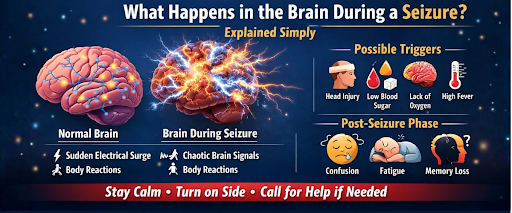
What Happens in the Brain During a Seizure? Explained Simply
May 2, 2026
Seizures can look frightening—but understanding what’s happening inside the brain makes them much less mysterious.
Let’s break it down in the simplest way possible.
The Brain Works Like an Electrical Network
Your brain is made up of billions of nerve cells called neurons. These cells communicate with each other using tiny electrical signals.
Think of it like:
- A well-organized power grid
- Signals flowing smoothly
- Each message reaching the right place at the right time
This controlled activity helps you:
- Think
- Move
- Feel
- Stay aware
What Is a Seizure?
A seizure happens when there is a sudden burst of abnormal electrical activity in the brain.
Instead of smooth, controlled signals:
- The brain experiences an electrical “storm”
- Signals become chaotic and excessive
- Normal brain function is temporarily disrupted
What Actually Happens During a Seizure?
Here’s what’s going on step-by-step:
1. Sudden Electrical Surge
A group of neurons starts firing rapidly and uncontrollably.
2. Signals Spread
This abnormal activity may:
- Stay in one area (partial/focal seizure)
- Spread across the whole brain (generalized seizure)
3. Brain Function Disruption
Depending on the affected area, it can impact:
- Movement → jerking or stiffness
- Awareness → confusion or unconsciousness
- Senses → strange feelings or hallucinations
4. Body Reactions
You may see:
- Shaking or convulsions
- Sudden collapse
- Staring spells
- Temporary breathing changes
Why Do Seizures Happen?
Seizures are not a disease—they’re a symptom. They can be triggered by:
- Head injury
- Low blood sugar
- Lack of oxygen
- Brain conditions (tumor, stroke, infection)
- Drug or alcohol withdrawal
- Fever in young children
How Long Do Seizures Last?
Most seizures:
- Last less than 5 minutes
- Stop on their own
But if a seizure:
- Lasts longer than 5 minutes
- Happens repeatedly
It becomes a medical emergency
What Happens After a Seizure?
After the electrical storm settles, the brain needs time to recover.
This is called the post-seizure phase, and the person may:
- Feel tired or sleepy
- Be confused or disoriented
- Have a headache
- Not remember what happened
Simple First Aid Tips
If you ever see someone having a seizure:
✔ Stay calm
✔ Protect their head
✔ Turn them on their side (when safe)
✔ Remove nearby dangers
❌ Do NOT put anything in their mouth
❌ Do NOT hold them down
Call for help if needed.
Final Thoughts
A seizure may look dramatic, but it’s essentially a temporary electrical disruption in the brain.
Understanding this helps you:
- Stay calm
- Respond correctly
- Potentially save a life
Popular Posts
-
Childcare First Aid Course Requirements in Australia: Everything You Need to Know
July 22, 2026Working in the childcare and early education sector comes with significant responsibilities. Whether you are...
-
First Aid Certificate Course Midland WA: Everything You Need to Know Before You Enrol
July 17, 2026Accidents and medical emergencies can happen anywhere—at home, in the workplace, at school, or even...
-
Paediatric Resuscitation Guidelines for Healthcare Workers: An Essential Guide for Australian Clinical Practice
July 8, 2026Paediatric emergencies are among the most challenging situations healthcare workers encounter. Unlike adult patients, infants...
-
Traumatic Cardiac Arrest Management: A Practical Guide for Faster Emergency Response in Australia
July 6, 2026Traumatic cardiac arrest (TCA) is one of the most critical medical emergencies a person can...
-
How to Use an AED in an Emergency: A Step-by-Step Guide for Australians
July 1, 2026Every minute counts during a cardiac emergency. When someone suffers a sudden cardiac arrest (SCA),...