
First Aid Management of The Agitated Person
September 21, 2026
An agitated person can be difficult to approach, particularly when their behaviour is unpredictable, distressed, confused, or aggressive. Agitation can occur for many different reasons, including emotional distress, illness, injury, medication effects, substance use, withdrawal, confusion, or an underlying medical or mental health emergency.
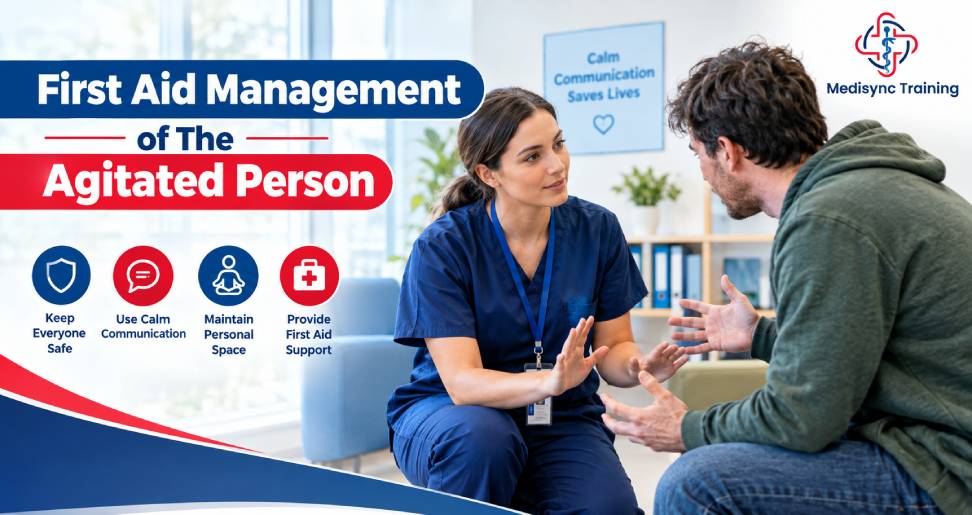
Knowing how to respond calmly and safely is an important first-aid skill. The priority is not to physically control the person or argue with them. Instead, first aid focuses on maintaining safety, communicating calmly, recognising possible medical emergencies, and arranging professional assistance when necessary.
For people working in healthcare, education, childcare, community services, workplaces, or other public-facing environments, appropriate first-aid training can help build confidence when responding to challenging situations.
What Is Agitation?
Agitation describes a state in which a person may appear unusually restless, distressed, angry, confused, anxious, or verbally or physically aggressive. The behaviour can range from pacing and shouting to threatening actions or attempts to harm themselves or others.
Sudden agitation can sometimes indicate an underlying medical problem. For example, acute confusion or disorientation can be associated with conditions such as infection, dehydration, neurological problems, substance effects, or other illnesses. Sudden disorientation accompanied by agitation should receive urgent medical attention.
Because the cause may not be immediately obvious, avoid assuming that the person is simply being difficult or deliberately behaving badly.
First Priority: Check for Danger
Before approaching an agitated person, assess the surroundings.
Look for anything that could place you, the person, or other people at risk. Maintain enough distance to give yourself room to move away, and avoid blocking the person’s exit.
If possible:
- Remove other people from the immediate area.
- Keep a clear escape route for yourself.
- Ask bystanders to move away.
- Avoid sudden movements or unnecessary physical contact.
- Do not attempt to restrain the person unless you are specifically trained and authorised to do so.
- Remove potentially dangerous objects only when this can be done safely.
If the person has a weapon or presents an immediate threat, do not put yourself at risk. Move to a safe location and call 000 for emergency assistance. Healthdirect advises calling 000 when someone is in immediate danger of harming themselves or others.
Stay Calm and Communicate Clearly
Your communication can influence how the situation develops. Use a calm, respectful voice and keep your language simple.
Introduce yourself and explain why you are there. Allow the person enough time to respond rather than asking multiple questions quickly.
Helpful approaches include:
- Speak slowly and calmly.
- Use short and clear sentences.
- Listen without interrupting.
- Acknowledge that the person appears distressed.
- Give them appropriate personal space.
- Avoid arguing about their beliefs or statements.
- Avoid threatening, criticising, or humiliating language.
- Ask simple questions to identify what they need.
For example, instead of saying, “Calm down,” you could say, “I can see that you’re upset. I’m here to help. Can you tell me what is troubling you?”
Healthdirect recommends listening more than talking, approaching carefully, maintaining a safe distance, and speaking calmly when supporting someone experiencing a mental health crisis.
Look for Possible Medical Causes
Agitation should not automatically be treated as a behavioural problem. Look for signs that the person may be experiencing a physical or medical emergency.
Consider whether the person has:
- Difficulty breathing
- Chest pain
- Severe bleeding
- A head injury
- Signs of poisoning or drug intoxication
- Seizures
- Severe confusion
- Loss of consciousness
- Sudden weakness or difficulty speaking
- Very abnormal behaviour following an injury
- Signs of severe allergic reaction
- Extreme drowsiness or collapse
If the person’s condition appears serious or is rapidly deteriorating, call 000 and follow the emergency operator’s instructions.
For example, healthdirect notes that dangerous drug or alcohol effects may include breathing difficulties, severe drowsiness, seizures, collapse, vomiting, hallucinations, and agitation.
Use the DRSABCD Approach When Appropriate
If the situation becomes a first-aid emergency, the standard DRSABCD approach can help structure your response.
D – Danger: Check whether the environment is safe.
R – Response: Check whether the person responds appropriately.
S – Send for help: Call 000 when emergency assistance is required.
A – Airway: Check and maintain the airway when appropriate.
B – Breathing: Check whether the person is breathing normally.
C – CPR: If the person is unresponsive and not breathing normally, commence CPR.
D – Defibrillation: Use an AED as soon as one is available and follow its instructions.
Healthdirect recommends DRSABCD as a fundamental first-aid action plan for emergencies.
A recognised First Aid Certificate course can help participants develop practical skills for responding to a broad range of emergencies. Medisync Training’s HLTAID011 Provide First Aid course combines online learning with face-to-face practical training and scenario-based assessment.
When to Call 000
Do not wait for the situation to become violent before seeking professional help.
Call 000 when:
- The person threatens serious harm to themselves or someone else.
- They have a weapon.
- They are becoming increasingly aggressive and cannot be safely managed.
- They are severely confused or disoriented.
- They have difficulty breathing.
- They become unconscious.
- They experience a seizure.
- They have suffered a significant injury.
- You suspect poisoning or a dangerous drug reaction.
- Their condition is rapidly worsening.
If the person becomes violent and you cannot remain safely nearby, move away and contact emergency services from a safe location.
What You Should Avoid
Some responses can unintentionally increase agitation.
Avoid:
- Shouting or raising your voice.
- Challenging or threatening the person.
- Crowding them.
- Making sudden physical contact.
- Surrounding them with several people.
- Laughing at or mocking them.
- Arguing about their perceptions.
- Making promises you cannot keep.
- Trying to physically restrain them without appropriate training and authority.
Your objective should be to reduce stimulation and maintain safety while waiting for appropriate assistance.
Why First Aid Training Matters
First aid is not limited to treating visible injuries. It also involves recognising emergencies, assessing risks, communicating effectively, and knowing when professional medical assistance is required.
Medisync Training provides practical, blended first-aid education designed to help learners develop emergency-response skills. Its training options include CPR Course, First Aid Certificate, Childcare First Aid Course, and Medication Training.
For childcare professionals, the Childcare First Aid Course can be particularly useful because children may respond differently to stressful situations and require age-appropriate emergency care.
Workplaces can also benefit from group training. Medisync Training offers workplace and group training options, with trainers able to deliver sessions at workplace locations in Perth.
Building Confidence Through Practical Training
Reading first-aid information is useful, but practical training provides an opportunity to practise emergency procedures under appropriate supervision.
Medisync Training uses blended learning, combining self-paced online theory with practical face-to-face sessions. Its first-aid training includes scenario-based activities designed to help learners apply their knowledge rather than simply memorise information.
Training can also help participants understand their own limitations. A first aider should not take unnecessary risks or attempt to replace emergency medical professionals. The safest response is often to protect yourself and others, contact emergency services, and follow the instructions provided by qualified professionals.
Final Thoughts
The first aid management of an agitated person begins with safety, calm communication, observation, and appropriate escalation. Do not assume that agitation is simply bad behaviour. Sudden agitation or confusion can sometimes indicate a serious medical, substance-related, or mental health emergency.
Keep your distance, avoid confrontation, reduce unnecessary stimulation, and seek professional help when the person’s safety or the safety of others is at risk. In Australia, call 000 for immediate emergencies.
For people who want to improve their emergency-response knowledge and practical skills, Medisync Training offers recognised first-aid and CPR training designed around real-world scenarios. Developing these skills can help individuals respond more confidently and appropriately when an unexpected emergency occurs.
Popular Posts
-
First Aid for Amputations: Emergency Response Guide
October 21, 2026An amputation is a serious medical emergency that occurs when a body part, such as...
-
First Aid for Neck Injuries After an Accident: What You Should Do
October 16, 2026Neck injuries can occur unexpectedly after road accidents, workplace incidents, sports injuries, or accidental falls....
-
First Aid for Back and Spinal Injuries: What You Should Do in an Emergency
October 15, 2026Back and spinal injuries can occur unexpectedly at home, in the workplace, during sports activities,...
-
First Aid for Joint Injuries: Essential Steps to Reduce Pain and Prevent Further Damage
October 14, 2026Joint injuries can happen unexpectedly during sports, exercise, workplace activities, household tasks, or everyday movement....
-
First Aid for Dislocations: What to Do and What to Avoid
October 13, 2026A dislocation occurs when a bone is forced out of its normal position within a...