
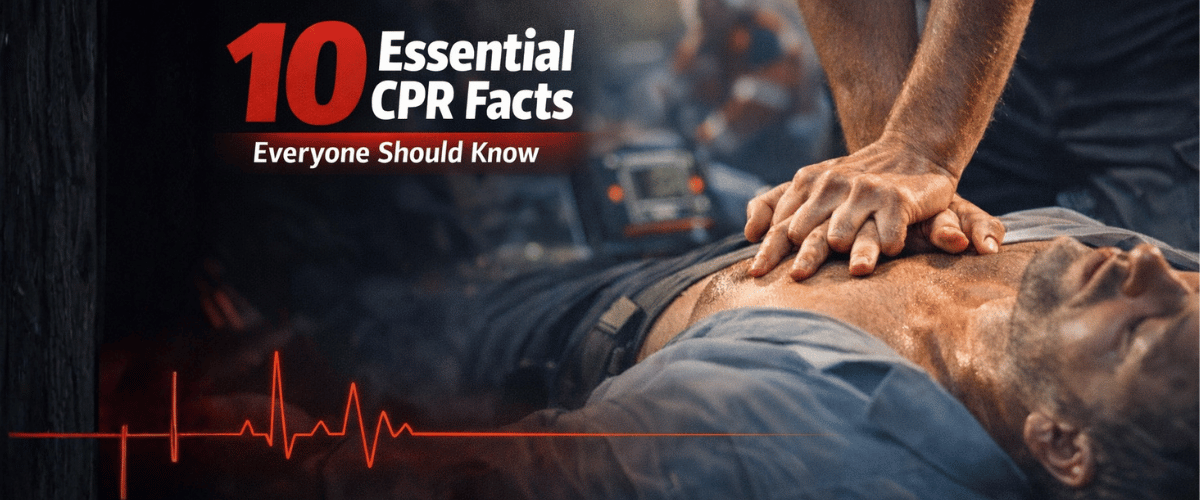
10 Essential CPR Facts Everyone Should Know
February 19, 2026
We’ve all seen the movies: a dramatic collapse, a hero rushes in, performs two seconds of chest compressions, and the victim suddenly coughs and sits up perfectly fine.
In the real world, Cardiopulmonary Resuscitation (CPR) is a bit more intense, far less cinematic, but infinitely more important. When someone’s heart stops beating—a condition known as Sudden Cardiac Arrest (SCA)—the clock doesn’t just start ticking; it starts racing.
Knowing the facts about CPR can be the difference between standing by helplessly and saving a life. Here are 10 essential facts that every human being should have in their toolkit.
1. Minutes are the New Seconds
When the heart stops, blood stops flowing to the brain. Brain damage can begin in as little as 4 minutes, and after 10 minutes, the chances of survival are slim. CPR acts as an external pump, keeping oxygenated blood moving to the brain and vital organs until professional help arrives.
2. You Don’t Need to Be a Doctor
A common myth is that you need a medical degree or years of training to perform CPR. While a certification class is highly recommended, Hands-Only CPR is incredibly effective. If you see a teen or adult collapse, you are qualified to help. Simply call emergency services and push hard and fast in the center of the chest.
3. “Stayin’ Alive” is More Than a Catchy Tune
To keep blood moving effectively, you need to hit a rhythm of 100 to 120 beats per minute. If you’re struggling to find the beat, hum the Bee Gees’ classic “Stayin’ Alive.” It is the gold standard for CPR timing. Other options? “Hips Don’t Lie” by Shakira or “Queen’s “Another One Bites the Dust” (though perhaps don’t sing that one out loud).
4. You Might Break a Rib (And That’s Okay)
One of the biggest fears people have is hurting the victim. Here’s the blunt truth: to perform effective CPR on an adult, you need to compress the chest at least 2 inches deep. This requires significant force, and yes, you might hear a crack or break a rib.
The Reality Check: A broken rib can heal; a stopped heart cannot. Don’t let the fear of injury stop you from saving a life.
5. Mouth-to-Mouth is Often Optional
For many, the “gross factor” of breathing into a stranger’s mouth prevents them from acting. Modern guidelines state that for adults, Hands-Only CPR is just as effective as traditional CPR in the first few minutes of a cardiac arrest. The body usually has enough oxygen left in the blood to keep the brain viable, as long as you keep that blood moving via compressions.
6. Most Cardiac Arrests Happen at Home
We often imagine needing CPR in a grocery store or a stadium. However, nearly 70% of out-of-hospital cardiac arrests occur in private residential settings. This means that if you learn CPR, the life you save is most likely to be that of a parent, a spouse, or a friend.
7. The AED is Your Best Friend
An Automated External Defibrillator (AED) is a “smart” device that can shock the heart back into a normal rhythm. These are found in most malls, airports, and offices. Don’t be intimidated by them—they are designed for people with zero training. Once turned on, the device literally speaks to you, giving step-by-step instructions.
8. The “Good Samaritan” Laws Have Your Back
Many people hesitate to help because they fear being sued if things go wrong. In most jurisdictions, Good Samaritan laws protect bystanders who provide CPR in good faith. As long as you aren’t being intentionally negligent, the law is on your side.
9. Women Are Less Likely to Receive CPR
Studies show that women are less likely to receive bystander CPR in public than men, often due to rescuers feeling uncomfortable touching a woman’s chest. This hesitation costs lives. It is vital to remember that medical emergencies have no gender—the procedure remains the same.
10. CPR Doesn’t Usually “Restart” the Heart
Contrary to popular belief, CPR rarely makes the heart start beating on its own. Its primary goal is to buy time. It keeps the person “viable” until an AED or a paramedic with specialized drugs can arrive to provide the definitive “spark” needed to restore a pulse.
Comparison: Traditional vs. Hands-Only CPR
| Feature | Traditional CPR | Hands-Only CPR |
| Components | Compressions + Rescue Breaths | Chest Compressions Only |
| Best For | Drowning, Choking, Infants | Sudden Adult Collapse |
| Ratio | 30 compressions to 2 breaths | Continuous (100-120 bpm) |
| Difficulty | Higher (requires training) | Lower (easy for anyone) |
Take the Next Step
Knowing these facts is a fantastic start, but there is no substitute for muscle memory. Taking a local CPR certification class takes only a few hours of your time but gives you the confidence to act when every second counts.
Popular Posts
-
Childcare First Aid Course Requirements in Australia: Everything You Need to Know
July 22, 2026Working in the childcare and early education sector comes with significant responsibilities. Whether you are...
-
First Aid Certificate Course Midland WA: Everything You Need to Know Before You Enrol
July 17, 2026Accidents and medical emergencies can happen anywhere—at home, in the workplace, at school, or even...
-
Paediatric Resuscitation Guidelines for Healthcare Workers: An Essential Guide for Australian Clinical Practice
July 8, 2026Paediatric emergencies are among the most challenging situations healthcare workers encounter. Unlike adult patients, infants...
-
Traumatic Cardiac Arrest Management: A Practical Guide for Faster Emergency Response in Australia
July 6, 2026Traumatic cardiac arrest (TCA) is one of the most critical medical emergencies a person can...
-
How to Use an AED in an Emergency: A Step-by-Step Guide for Australians
July 1, 2026Every minute counts during a cardiac emergency. When someone suffers a sudden cardiac arrest (SCA),...